If today, faced with the challenge of global urbanization, we lack the time for slow accretion, speed should nonetheless be tempered by debate, allowing each topographical, social, and cultural situation to give rise to an authentic proposal.
One of the essential challenges of sustainable development is to resist the technocratic vertigo of ready-made solutions and instead preserve cultural continuities, local characteristics, and territorial identity.
The concept of a sustainable territory is therefore based on the commitment of local authorities to develop a comprehensive energy strategy aimed both at energy transition and territorial development. In a context of economic, energy, and ecological crisis, local governments now seek to equip themselves with infrastructure capable of meeting their energy needs while ensuring environmental protection. Achieving a “sustainable territory” thus requires combining different actions in energy production, energy efficiency, and the optimization of local resources.
The objective of these actions is to improve both quality of life and territorial attractiveness. For this reason, it is essential that the population (residents and businesses) be widely involved in the implementation of a sustainable territory. This requires establishing a clear strategy and roadmap in two phases:
First, assessing the existing conditions of the territory: available resources, socio-economic context, energy networks, land availability, infrastructure, and transportation—in order to determine precisely the area’s capacities.
Second, based on the information collected, defining the scope of the project.
In our study, the project aims to ensure continuity in a sustainable approach between the territorial scale and the architectural scale, through a housing and public space development project at the Citadel pier in Strasbourg.
It is part of the master plan for the Deux Rives project, whose ambition is to reclaim a neglected port area. The reconversion of industrial brownfields represents a major urban challenge. It is at the heart of these significant issues that the development of the Citadel pier takes place.
How, then, can the transformation of this district be prepared to meet new challenges and guarantee future generations energy security and a high-quality living environment? How can a common issue—housing—be addressed on a site shaped by the trend of reclaiming industrial brownfields, while responding to new energy concerns and the comfort expectations of urban dwellers? What benefits can arise from working on thresholds and transitions to create continuity at all scales—energetic, structural, perceptual, and functional?
By combining territorial analysis and architecture—drawing on experience with energy-autonomous territories and eco-districts—the project seeks to address the following question:
From the scale of the territory to that of architecture, how can continuity in a sustainable approach be achieved?
It is therefore essential to define the urban, landscape, and energy framework of our territory.
The site is part of the strategic context of the “Strasbourg–Kehl Metropolis of the Deux Rives” project, which aims to develop a new urban core extending from Heyritz to Kehl. It lies at the intersection of completed developments—the Cité de la Musique et de la Danse, the Rive Étoile district, the André Malraux Media Library—and projects under construction, including the Danube eco-district, the Starlette site, the Coopérative site, the Port du Rhin district, and the wider Deux Rives area.
The site is a peninsula of approximately 15 hectares, surrounded by the Dusuzeau and Citadelle basins, built in the 19th century to facilitate navigation on the Rhine and support the expansion of the Port of Strasbourg. Today, the decline of industrial activities has left more than half of the site abandoned. Nevertheless, three businesses remain: Cafés Sati, the Batorama workshops, and an annex of the Port of Strasbourg administration.
River activity is still present, with cruise boats operating along the Vauban basin. In addition, the construction of a marina on the southern bank of the pier will further enhance existing activities and the attractiveness of the site.
The pier will soon be served by the extension of tram line D, with a stop on site providing a direct connection to Strasbourg city center and to Kehl.
The northwestern part of the site was designed by the Reichen and Robert urban planning agency, responsible for the Strasbourg–Kehl axis master plan, proposing a mixed-use program.
Our project is located in the southwestern area of the Citadel pier, at the interface between the marina project, river activities, the riverside promenade, and the embankment.
At the center of the pier runs an embankment extending along the entire length of the peninsula. It forms a 28-meter-wide, 6-meter-high elongated and steep artificial landform—a former medieval bridge ramp that has spontaneously evolved into a grassy wasteland of shrubs and bushes.
Water is omnipresent on the site along the elevated riverbanks (1 to 5 meters high), accessible at the future marina, and also beneath the site itself.
Indeed, Strasbourg lies above the Rhine aquifer, the largest groundwater table in Europe.
These unique geographical elements—such as the aquifer—must be considered specific resources within our sustainable approach, structured around the triptych: production, storage, and restitution.
In our case, heat production could be ensured by the SETE power plant located at the Starlette site, which has very high thermal capacity. This cogeneration plant supplies the Esplanade district and university campus via a primary high-pressure hot water network, with heat exchangers transferring energy for domestic hot water.
The plant’s advantages are twofold: first, as a cogeneration plant, it has a very high efficiency factor. However, its reactors are not used continuously due to the lack of storage capacity—hence the interest, as demonstrated by projects such as Aulnoy in Valenciennes, in storing excess heat in the groundwater table. Second, the network enables heat to circulate with minimal loss to substations installed within housing units.
The project will complete the network loop by supporting necessary infrastructure across the new tram bridge and footbridge, allowing heat-carrying systems to cross the site.
Heat is produced year-round at the plant, excess heat is stored beneath the site, and it is redistributed through substations.
Another possible energy source involves the methanization of organic waste to provide primary energy for the SETE plant. Methanization produces heat and electricity from fermentable waste collected over a wider perimeter, potentially transported via the Rhine from wastewater treatment plants.
In return, the site could supply heat to new districts such as Starlette.
After developing local energy sources based on available territorial resources and geography, we turn to the project’s internal energy organization, particularly within the buildings.
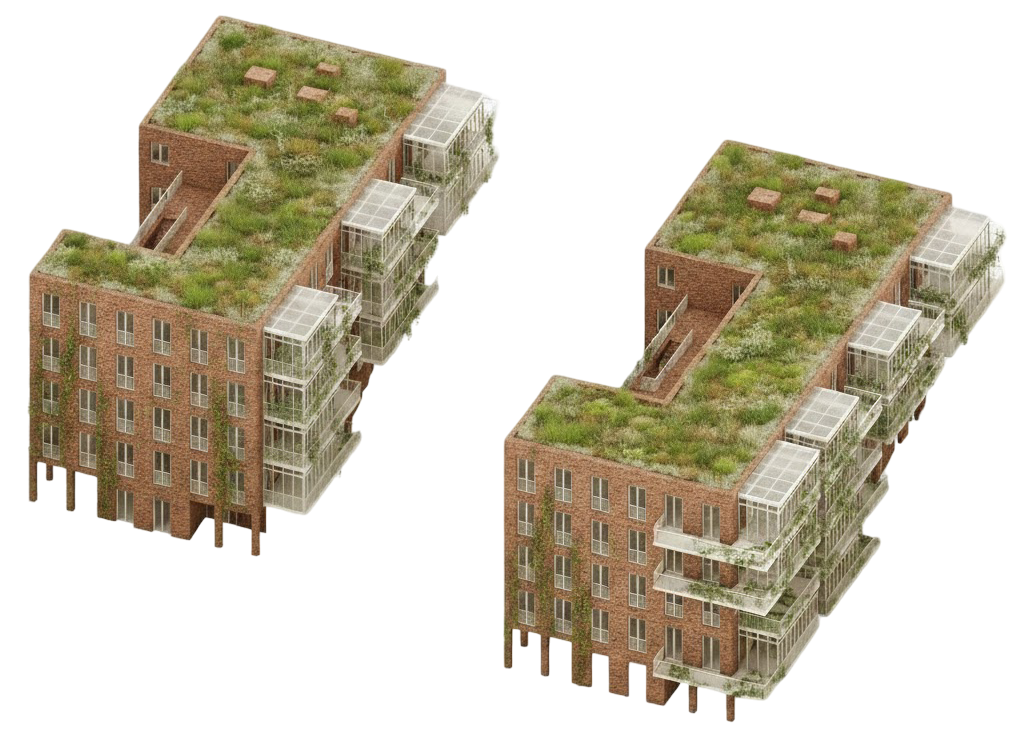
The layout and height of housing units are based on the sun’s path to maximize passive energy capture. Phased construction is also possible, optimizing costs through proven building techniques and modular repetition.
Two housing formats exist, designed on the same structural grid but adaptable to the site context.
Material choices depend on territorial influence. The presence of the Achenheim brick factory about fifteen kilometers away supports the use of high-performance brick, one of the most reliable technical materials.
At the unit level, energy performance is expressed through building morphology maximizing passive gains, greenhouse spaces serving as thermal buffers, and the integration of a dedicated substation. Each substation includes a heat exchanger connected to the SETE network, a shared domestic hot water tank, and a second exchanger for the heat pump.
The high-pressure water network runs through a technical embankment, preserving existing vegetation by minimizing impact on tree roots.
Beyond technical energy goals, the notion of “social energy” must also be considered. Raising residents’ awareness of local sustainable practices is essential to achieving energy sobriety. For this reason, buildings are organized as collective units with shared facilities such as washing machines, domestic hot water, and heating.
Ultimately, each occupant must recognize that territorial quality depends first and foremost on individual behavior. This “social energy” enables innovative operating models.
The overall energy performance of the solution depends on individual behavior. The individual is therefore central to the project, as actions fit within our triad: territory, energy, uses.
Architectural, structural, and landscape elements are conceived as opportunities for new uses of territory and energy.
The linear project along the embankment explores the connection between the city and the pier through a footbridge. This footbridge will reconnect the confluence to the Citadel Park, offering high-quality pathways integrated into broader circulation networks.
The riverside promenade around the pier must become a key feature, complementing the embankment promenade, both linked by braided pathways through the built fabric.
Urban design integrates these routes, allowing access from the embankment to the marina via multiple paths punctuated by distinctive elements such as the harbor master’s square, the embankment café, and flowered passages through gardens.
To limit car use, parking areas are concealed beneath a technical embankment adjoining the existing one. Circulation also uses the existing access road serving river activities.
The program enhances these activities with café terraces and offices directly accessible from the tram, located in renovated hangars near the marina and in the building south of the embankment.
The articulation building, most visible from afar, houses a café on the ground floor and mezzanine, with offices above. A distinct façade grid marks this different use.
The housing program consists of four units adjoining the embankment. A second typology along the marina quays, with different characteristics, is not detailed here.
Landscape plays a major role: the relationship to the Citadel Park, to water, vegetation integrated into architecture—climbing plants, hollyhocks, private gardens—extend the greenhouse concept and enhance well-being.
The embankment should reinforce neighborhood identity as a wooded place for relaxation and strolling.
Different paving types reflect varied uses, while swales at the base of the embankment enable natural drainage.
At the housing scale, the project explores thresholds to manage boundaries between public and private, user and resident, interior and exterior, living and sleeping spaces. Special attention is given to access spaces as transitional zones.
The northern gallery walkway becomes both an energetic and social transition space.
The ground floor opens onto the garden and provides access to bicycles, waste storage, and parking. The first floor houses bathrooms and laundry rooms in the less sunlit zone against the embankment, connected to the substation. Upper floors contain three apartments per level, except the top floor, which has four due to greater sun exposure.
Multiple terraces enhance housing quality. Adjacent to winter gardens, they offer varied uses—sometimes as loggias, sometimes as exterior greenhouses—blurring boundaries between inside and outside and allowing flexibility between privacy and engagement with urban life.
Interiors are simple, with brick occasionally reappearing. Technical networks are exposed to simplify construction and emphasize energy systems. Kitchens are visibly technical elements. Floors use hollow brick beam-and-block systems to maintain material continuity.
Life within these units is thus an exercise in coherence at all scales of perception and use.
Conclusion
Ultimately, embedding a project within a sustainable approach involves many stakeholders and redefines the architect’s role—working on continuity, hierarchy, and the interplay of constraints and intentions from the territorial scale to that of architecture.